


NASA studies the Namib's dunes as part of preparation for unmanned "Dragonfly" Space Mission to Saturn

Pictured Above: US Ambassador John Giordano welcomes Dr. Jani Radenbaugh in Windhoek and below: Dragonfly in an artist's impression. The space craft is currently under construction and ready for flight mid-2027.


Wednesday, 29 July 2026
By Floris Steenkamp (information and photo sources: US Mission in Namibia; NASA)
The National Aeronautics and Space Administration (NASA) has turned to the Namib Desert's vast dune fields—formed and shaped by the wind over millions of years—to better understand what to expect when its unmanned Dragonfly mission lands on Titan, Saturn's largest moon.
Although Saturn is a gas giant composed primarily of hydrogen and helium, its largest moon, Titan, has a solid surface and displays a remarkable variety of geological features. These include vast dune fields like those of the wind-swept Namib, as well as rivers, lakes and mountains, albeit composed of very different materials to those found on Earth.
This explains NASA's keen scientific interest in the Namib Desert, whose wind-shaped dunes provide one of Earth's closest natural analogues to those on Titan. Like the Namib, Titan's dunes have been formed and sculpted by the action of wind over immense periods of time.
Early in July this year, one of NASA's Dragonfly science team leaders, Dr Jani Radenbaugh of Brigham Young University's Department of Geological Sciences, arrived in Namibia to continue research on the country's dune fields.
Dr Radenbaugh was welcomed to Windhoek by the US Ambassador to Namibia, Amb. Giordano. "It is remarkable that one of Earth's oldest deserts is helping America to explore one of the most distant and intriguing worlds in our Solar System," the Ambassador remarked while receiving Dr Radenbaugh in his office.
Dr Radenbaugh led a team of 40 NASA scientists to Namibia's dune fields in 2025 in preparation for the Dragonfly mission. Her current research visit also coincided with her attendance at the 2026 International Conference on Aeolian Research—the scientific study of how wind shapes landscapes—which was held in Swakopmund.
Dragonfly, which is scheduled to launch next year in 2027, will only arrive at Titan in 2034. It consists of a lander module out of which an octocopter rotorcraft (an eight-bladed helicopter) will be activated to explore Titan's surface in flight. Titan's atmosphere is significantly denser than that of Earth, making flights possible, although it is not life-sustaining because of the absence of oxygen.
Dragonfly will land at intervals to recharge its power supply before taking off again. It will continue in this pattern throughout its mission.
Just two points of further interest: (a) a single day on Titan is equivalent to almost 16 Earth days. That means approximately eight Earth days of continuous daylight are followed by another eight Earth days of continuous darkness. Dragonfly does not rely on solar power to replenish its power supply, but merely relies on landing to replenish its power supply through the process breaking down an onboard source of plutonium. (b) the surface temperature of Titan is minus 300 Degree Celsius.
Titan also has a very thick atmosphere, which is significantly denser than Earth's which is one of the factors that makes the Dragonfly mission possible, together with the moon's solid surface.
One of Dragonfly's primary scientific objectives is to investigate conditions that resemble those on the early Earth before life emerged. Scientists believe Titan provides a unique cosmic window into the prebiotic Earth, long before even the simplest forms of microbial life existed here.
The facts:

Thursday, 9 July 2026
Author: The MD of Daron Namibia (Pty) Ltd, Mr. Luther Mostert
Recent reporting on the MV Venus 1 matter has described allegations made against Daron Namibia (Pty) Ltd and its managing director in arbitration and court papers. Daron denies wrongdoing. Because those allegations are now being repeated as though they were established facts, the company has taken this space to set out what the contemporaneous documents — agreements, letters, bank instructions and messages exchanged at the time — actually record. Readers should know that every statement below is drawn from a dated source document, and that the underlying dispute is before an arbitral tribunal and the High Court of Namibia, where nothing has yet been decided.
Hodago approached Daron — not the other way around. The relationship began in mid-2025, when representatives of Hodago Fishing (Pty) Ltd approached Daron for operational and funding support for the fishing vessel MV Venus 1. In September 2025 Hodago's board accepted Daron's services proposal, and on 24 September 2025 Hodago's chairman recorded in writing: "we have taken the decision to appoint you." Two days later, on 26 September 2025, Hodago and Daron signed a Vessel Management Service Level Agreement. Daron was never the fishing quota holder and has never owned Hodago.
Fond Social itself signed Daron's appointment. On 10 November 2025, Fond Social de la RDC, Hodago and Daron together signed Addendum No. 2 to the main quota exploitation agreement of 24 September 2025. That addendum — signed by Fond Social's own representatives — appointed Daron as technical vessel manager and recorded the banking arrangements for the project. Daron's role was therefore not hidden from anyone: it was contracted for, in writing, by the very party now making allegations against it.
Daron funded a distressed vessel when no one else did. The MV Venus 1 was in serious operational and financial distress. The project record contains 348 supplier invoices and 107 proofs of payment between September 2025 and February 2026 for fuel, crew, provisions, repairs, port charges and statutory levies arranged or advanced through Daron. On 20 September 2025 Hodago's chairman signed a letter acknowledging N$6,957,341 in fuel funding from Daron and undertaking priority repayment. By late October 2025 Daron's recorded exposure for bunkers and supplies had reached approximately N$8.6 million. Hodago's own directors repeatedly confirmed the debt in writing — including, as late as March 2026, that Daron holds security over the catch. Daron remains unpaid for substantial amounts.
The "escrow" claim must be tested against the bank documents. It has been alleged that bank signing arrangements were manipulated. Daron disputes this. The account mandates, board resolutions and bank instructions exist as dated documents and must be read in the order in which they were made. Daron has provided these records to its legal team and stands by what they show. Characterisations in pleadings are not evidence; the bank's own paperwork is.
Where matters stand. On 11 February 2026, Fond Social's attorneys purported to terminate the September 2025 agreement, demanding among other things the surrender of banking arrangements within one day. Daron disputes the lawfulness of that termination and of the conduct that followed. Fond Social thereafter commenced arbitration (30 March 2026) and court proceedings; Daron is defending both. It bears repeating: allegations in a statement of claim are allegations. No tribunal or court has made any finding against Daron or its managing director.
Daron Namibia's position is simple: it was the service provider and vessel manager that kept the MV Venus 1 project alive with its own resources, under written agreements signed by all parties — including Fond Social. The company has opened its documentary record to scrutiny and invites any journalist covering this matter to test the allegations against the dated source documents rather than repeating one side's pleadings. The matter will be decided where it should be: in the legal forums now seized of it.
Supplied and paid for by Daron Namibia (Pty) Ltd.
Hentiesbaai soek weer die "waterhef" in sy eie hande - koopwatermeters moet waai....

Tuesday, 30 June 2026
By Floris Steenkamp
Hentiesbaai wil weer die hef in die hand hê met watervoorsiening. ITEM Engineering se koopwatermeters moet waai. Die dorp se ou rolmeters kom terug [vir eers].
Die dorp gaan reeds vir sy vierde dag gebukkend onder watertekorte nadat die munisipaliteit en koopwaterdiensverskaffer, ITEM Engineering, 'n uitval oor betalings gehad het.
ITEM Engineering het verlede Vrydag (26 Junie 2026) watervoorsiening aan Hentiesbaai summier opgeskort. Die onderneming dring glo aan op 'n betaling van meer as N$11 miljoen van die munisipaliteit van Hentiesbaai alvorens toevoer herstel sal word.
Meer as 3 500 persele op Hentiesbaai het koopwatermeters wat deur ITEM Engineering verskaf is. ITEM beheer die administrasie van die watertoevoer namens die munisipaliteit met 'n rekenaarstelsel. Toevoer kan met die spreukwoordelike "druk van 'n knoppie" opgeskort word.
En Vrydag net voor die middaguur het ITEM inderdaad die knoppie gedruk. Inwoners kon eensklaps nie meer koopwaterkrediete by die munispale kantore koop nie, en so ook nie by die twee private agente, Spar Hentiesbaai of Total diensstasie, nie.
Diegene wat nog krediete op hul watermeters gehad het, was vir eers uit 'n penarie, maar diegene met min krediete was spoedig sonder watertoevoer gelaat.
In 'n openbare vergadering wat gisteraand (29 Junie 2026) deur die munisipaliteit belê is, is ITEM gekritiseer vir sy autokratiese optrede.
Inwoners voel verontreg oor die wyse waarop ITEM Engineering die saak hanteer het. En dit terwyl die saak eintlik tussen die munisipaliteit en ITEM Engineering besleg moet word.
Inwoners het na afloop van die vergadering gisteraand die munisipaliteit geloof vir sy optrede sedert die opskorting van die watertoevoer.
'n Munisipale span het inwoners, wat nie meer waterkrediete het nie, se koopwatermeters verwyder en dit met die ou rolmeters vervang. Toevoer kon sodoende herstel word.
En nou gaan dit deurgaans gedoen word. As jou waterkrediete opgebruik is, word die meter verwyder en die rolmeter vat weer sy volwaardige plek in. Natuurlik nou is dit weer waterrekeninge.
Inwoners was ook ingenoë met die openlikheid en die eerlikheid waarmee die munisipaliteit tydens die vergadering na vore gekom het.
In die komende dae sal die kontrak vir koopwatervoorsiening tussen die munisipaliteit en ITEM Engineering die fokuspunt word.
Daar is heelwat vrae:
1. Was daar destyds 'n tender uitgesit vir 'n koopwaterstelsel?
2. Hoe was die keuse van 'n voorsiener gemaak?
2. Wat was die betalingsooreenkoms? ITEM voer aan dit moes volgens 'n vorderingsskedule geskied.
Die kontrak maak dit seer sekerlik oop vir 'n ander interpretasie. Die volle betaling, van net oor die N$11 miljoen, is volgens dit eers op die laaste dag van die 26/27 begrotingsjaar op 30 Junie 2027 betaalbaar.
Die gees wat nou onder Hentiesbaaiers heers is dat ITEM Engineering sy metertjies moet pak en vertrek.
Dit is onaanvaarbaar dat 'n Grondwetlike reg op water, en die mag om watertoevoer op te skort, in die hande van 'n privaat onderneming lê, word gesê.
Nota: dit is reeds die derde dag wat ITEM Engineering nie op enige pogings to navrae deur The Atlantic Gazette reageer nie.

Tourism arrivals drop with 3,2 % - Is there cause for concern?

Friday, 26 June 2026
By Floris Steenkamp
Namibia has seen a drop in tourism arrivals in 2025 by a total of 3,3 % from 2024 to 2025. That represents a drop by 3,2 % according to the Minister of Environment and Tourism, Indileni Daniel. This percentage drop can be attributed to the bigger picture with regard to the recovery of tourist arrival figures pre-Covid, the recovering years directly following Covid-19 and now the post-Covid pattern.
Namibia's pre-Covid 19 tourism figures show 1,6 million tourist arrivals in 2019. The years 2020 and 2021 was, as the worldwide tendency, devastating for tourism arrival numbers.
In 2022 it recovered to 461 027 and doubled in 2023 to 863 872.
In 2024 the arrivals saw an improvement of 32 % to 1 257 093).
The decline of 3,2 % from 2024 to 2025 shows an almost stagnant figure or perhaps arrival numbers have reached a saturation point and needs Namibia's public and private tourism stakeholders to innovate to take arrival numbers to the next level, two tourism stakeholders explained when asked about this pattern.
Namdock scammed out of N$4 million by Chinese crooks - nobody to take responsibility

Thursday, 28 May 2026
By Floris Steenkamp
"There is nothing we can do. Nobody is going to be dismissed, prosecuted in Namibia or even held criminally liable in China".
This was the response by a top stakeholder in Namdock after it became public that Namdock lost N$4 million in a transaction to acquire steel from China.
Contrary to national media reports the steel was "purchased" for the amount of N$4 million and never delivered, the truth is much harsher than that.
"It is simple. Namdock decided to acquire steel directly from China as it is cheaper. However, despite warnings to Namdocks' Board of Directors no due dillegence exercises were carried out on the supplier, and it turned out this "steel provider" was nothing more than a common scammer.
Once Namdock paid a N$4 million deposit for the delivery of the steel this provider disappeared and only weeks later the truth dawned that this was a scammer", The Atlantic Gazette was informed this week.
It was further revealed this ill-fated transaction already occurred in 2024. Furthermore, no criminal prosecution either in Namibia or China is possible, and neither did members of the Board of Directors of Namdock at the time acceptted accountability as this transaction took place during their time as gatekeepers.
Namdock is 52,5 % owned by Namport and 47,5 % owned by EBH Consortium.
Strait of Hormuz remains thorn in global flesh



Thursday, 7 May 2026
By Floris Steenkamp
Slightly less than three hours remain before Namibia’s much anticipated fuel price adjustment is to be announced in Windhoek by the Minister of Industries, Mines and Energy, Mr. Modestus Amutse.
This announcement and Minister Amutse’s briefing to the nation as to the status of fuel supply in the country will take place at the backdrop of the global economy remaining vulnerable to crude oil and fuel supply gluts.
The blockade of the Strait of Hormuz in the Middle East continues by the United States Navy keeping commercial and global fuel supply export shipping trapped in the Persian Gulf and simultaneously blocking shipping underway into the Gulf from the Strait of Oman. Either direction shipping must pass through the Strait of Hormuz which Iran for many decades held as a trump-card (mind the pun) to blackmail the global community to accept its repressive Islamic regime to remain in power, continuing to work towards developing a nuclear weapon and supplying arms and money to its terror proxy groups in the Middle-East (the Houthis in Yemen, Hamas in Gaza, Hezbollah in Lebanon, the Assad-regime in Syria (now defeated), and pro-Iranian terror groups in Iraq. Also calling for the destruction of the State of Israel and the United States.
There is much debate in recent weeks as to the sources and availability of global fuel supplies to Namibia, but the ongoing tensions between the US and ally Israel and Iran keeps the global market prices for crude oil high.
There are little prospects the situation would change for the better should the blockade of Hormuz remains. The stumbling block for now is Iran’s refusal to sign a peace deal that would end its nuclear ambitions (the US’s main demand) and to stop all hostilities in the Strait of Hormuz to free up global shipping.
The United States commenced “Project Freedom” on Sunday to protect ships exiting the Persian Gulf, but Iran continues its blockade of the Strait, albeit with almost its entire military power wiped out by Israel and the US.
The past weeks also saw another major shift in Middle East relations when Iran started military attacks Gulf countries, most notably the United Arab Emirates (UAE) and Saudi Arabia the worst affected. The aftermath: Gulf countries are preparing for war with Iran, the UAE left OPEC and OPEC (Organisation for Petroleum Export Countries) and OPEC Plus (for non-Arab countries that also joined OPEC and Saudia Arabia made an exit from OAPEC (Organisation for Arab Petroleum Export Countries.
Although both the UAE and Saudi Arabia are oil producing giants which can now add volumes to global crude oil and fuel trade volumes these countries remain restrained if the Strait of Hormuz remains trapped in the current geopolitical cauldron.

Namport issues warning over high sea swells

Monday, 4 May 2026
By Floris Steenkamp
Port of Walvis Bay – A safety warning has been issued to all vessels in the main port (berths 1 to 7 and the New Container Terminal) as strong winter swells continue to affect the port. These rough conditions have already caused several mooring ropes to snap, especially at berths 7 to 9 and at the New Container Terminal, according to the warning issued by the office of the Port Captain.
Ship captains and masters have been urged to stay alert and take responsibility for the safety of their vessels at all times. Regulations also require that enough crew members remain on board to manage mooring lines and other critical connections while ships are in port.
Port authorities have outlined key safety steps:
-
Any vessel experiencing problems due to the swell must report immediately to Port Control via VHF radio or telephone.
-
Port Control will issue navigation warnings over VHF radio when bad weather is expected.
-
Captains must ensure they have up-to-date weather forecasts on the bridge.
The advisory highlights the increased risks posed by seasonal sea conditions and calls for heightened vigilance to prevent damage to vessels and ensure crew safety.
Coastal News
Superyacht "Salt" calls at Walvis Bay on 10 May '26


Wednesday, 29 April 2026
By Floris Steenkamp
Apart from the call at the port of Walvis Bay on 11 May this year of the Brazilian offshore patrol vessel "Araguari", the superyacht "Salt" is expected alongside a day earlier on the 10th. "Salt" is currently docked in Cape Town, but her passenger list is a super secret as she is a charter yacht only meant for the famous and the rich. It is expected she will be making a passage of the South Atlantic after her call at Walvis Bay.

Recycling giant Epic Group to put an end to Walvis Bay's used tire problem "within the next month"!

Wednesday, 29 April 2026
By Floris Steenkamp
A N$25 million used vehicle tire processing plant is soon to commence operations in Windhoek, with a capacity to process 2 500 tons of used tires monthly. In fact, the plant forms part of a more than N$100 million investment by the Epic Group one of Namibia’s leaders in mass recycling.
The plant already started up for test runs earlier this week, according to a stakeholder in the business, Mr. Dave Gallagher. The project forms part of Epic Global Recycling, subsidiary of the Epic Group.
Epic Group owns and operates several recycling depots countrywide, including Walvis Bay where it expects to start collecting used tires within a month’s time for transport and processing at its state-of-the-art tire processing plant in Windhoek, The Atlantic Gazette was told in a telephone interview with Mr. Gallager on Tuesday of this week.
Countrywide the accumulation of used vehicle tires at dumping sites poses a challenge. It includes fire risks, and we strive to raise the bar of how Namibia manages the challenge with used vehicle tires.
Epic Global Recycling will use the Epic Group’s national infrastructure to collect used tires and prepare it locally for transport. Epic Global Recycling is also in the process to establish a similar collection point at Arandis and is in the process to obtain land in Walvis Bay which will be used as a staging area for collection, loading and transport, The Atlantic Gazette was told.
Mr. Gallagher called upon vehicle tire dealers at Walvis Bay and Swakopmund to put their weight behind Epic Global Recycling as together the challenge with used vehicle tires can be turned into opportunity.
Dealers will be required to pay a fee to cover the cost of preparation and transport, and the aim of the local authorities in both Walvis Bay, Swakopmund and Henties Bay is to put a total halt to the dumping of used tires at municipal waste disposal sites. Walvis Bay municipality recently announced it has closed the waste disposal site for the dumping of used vehicle tires with immediate effect.
For inquires:
Mr. Dave Gallagher – 081 22 1501 - Dave@tirecycling.com.na
Mr. Jarred Jordaan 081 777 1838 – Jarred@tirecycling.com.na

President Ndaitwah calls for investment in Namibia's seal fisheries, but do we have all the facts?
Tuesday, 28 April 2026
By Floris Steenkamp
Namibia's President Netumbo Nandi-Ndaitwah at the recent three-days conslutations with the fishing industry in Walvis Bay called for investment in the country's seal industry, both to create a commercial platform for value adding and job creation, but also to manage rising seal populations.
President Ndaitwah declared she would be "the happies president" if anyone could step forward to build a sealing industry. The President offered Government support with land, financing and regulatory processes for seal processing. The President encouraged investors to tap into this process.
President Ndaitwah's remarks comes in stark contrast to the shocking and internationally embarrassing incident at Henties Bay at the end of November 2025 in which some 1 400 seals were harvested at Torra Bay, only to be left to rot out in the desert when the logistics were inadequate to transport the carcasses for processing.
A Pictures above show how reefer containers were left out in the desert near Henties Bay, containing carcasses left to rot. At the end of this article are two links to The Atlantic Gazette TV on YouTube where we published two videos explaining this situation. Hope is expressed these videos brought under the attention of President Ndaitwah as there is no doubt the President will take action without doubt.
The containers were originally stored in Henties Bay on a premises where a seal factory was yet to be constructed. The containers were removed from Henties Bay's townlands due to a serious health risk developing. Other containers and carcasses were dumped at Arandis where it too created a hygiene threat of major proportions.
Chinese businesswoman Stina Wu and a company by the name of Vigor Biotechnology (Pty) Ltd. are behind this incident and to this very day neither The Ministry of Agriculture, Fisheries, Water and Land Reform lifted a finger, alternatively informing Namibians, if an investigation is launched against Stina Wu for the dumping of marine resources. Neither were questions asked as to how Wu in the first place obtained permission to carry out seal harvesting activities in Henties Bay. She has no seal processing facility yet and instead it was decided to process the carcasses at a warehouse in Arandis. It all ended in an unhygienic mess of massive proportions and in itself warrants an investigation.
Then there is another open ended question: were there a fisheries observer present when the seal were harvested last year? Surely seals count as marine resources and by law officials of the Ministry of Agriculture, Fisheries, Water and Land Reform had to monitor and record the harvesting that took place. Questions are now whether the Ministry had officials on the ground and whether the events of end November at Torra Bay constitute illegal dumping. Then also will Stina Wu be held accountable for the actions of her company and the people that took part in the project?
Regarding the President's remark that seal populations need to be managed. The Ministry of Agriculture, Fisheries, Water and Land Reform need as a matter of urgency conduct consultations with the fisheries and conservation science fraternity of Namibia. We as Namibians miss an important scientific truth and that is seal populations actually stimulate fish population growth and not destroying it as the uninformed assumption. Below are the links to our YouTube platform The Atlantic Gazette TV:


Brazilian offshore patrol vessel to call at Walvis Bay

Tuesday, 28 April 2026
By Floris Steenkamp
One of Namibia's closest naval allies, Brazil's offshore patrol vessel "Araguari" is expected to dock in Walvis Bay on 11 May this as part of a routine diplomatic call. The vessel's last call at Walvis Bay was on 14 February 2023.
The passenger ship "Seven Seas Mariner" is also olongside on 11 May.
Monday, 27 April 2026
By Floris Steenkamp
Walvis Bay mayor Cllr. Johannes Shimbilinga has been delivering a keynote address at the Dunes Mall in the harbour town on Saturday morning upon invitation by the Malaysian High Commission in Namibia.
Only a few blocks away from this glamour event, quite the opposite played out. Some 300 residents were protesting at the civic centre against the continued illegal fires at the Walvis Bay dumpsite, started by people illegally living there. The group had a petition to hand over to the deputy mayor of town, Cllr. Miina Hangula.
As the events took place on Saturday morning respectively at Dunes Mall and at the civic centre smoke was seen billowing from the dumpsite as illegal squatters were burning waste and possibly also discarded vehicle tires.
Hangula was nowhere to be seen or found on Saturday morning, to accept the petition just after 09:00. After several failed attempts to reach her on cell phone, the Mayor Cllr Shimbilinga at the eleventh hour decided to delegate the Councillor for the Joint Walvis Bay Residents Association, Cllr. Sharon Roodt, to receive the petition on behalf of Council.
This incident is in start contrast to a recent declaration by the Ministry of Environment and Tourism that the dump site in Walvis Bay is the subject of huge environmental and local authority management concern.
“The event of this morning speaks for itself”, very disappointed protesters said. Adding the time has come for the municipality of Walvis Bay, not town councillors, to take responsibility for failures at the dump site.
It is because of the incompetence of at least one senior municipal official that the dump site spilled over from the Walvis Bay townlands to the Dorob National Park. Protestors who spoke to The Atlantic Gazette said they are surprised that this senior official remains in charge and that no disciplinary action had been taken against him by his seniors when it became known during the latter half of 2025 that the dumpsite is now partly situated on Dorob National Park land.
“We demand action been taken. We demand the municipality make interim arrangements to accommodate the dumpsite on alternatives portions at the segment of the dumpsite situated within the townlands.
Mayor addresses Malaysian event at Dunes Mall as protestors dodged by Walvis Bay deputy Mayor

Huge concerns over opening of the 200m depth zone for horse mackerel trawling.
Fisheries scientists and senior officials feels abandoned astheir voices don't count in the new Agriculture ministry. They recommended 200m zone NOT to be opened as it would end catastrophic for horse mackerel's future.

Monday, 27 April 2026
By Floris Steenkamp
Namibia’s Cabinet already approved the relaxation of the 200m depth zone to 150m for the wet-landed horse mackerel sector two days prior to the arrival in Walvis Bay last week of President Netumbo Nandi-Ndaitwah for the much-publicised consultation meeting with the fishing industry. "If it was a consultative process, how arriving prepared with a decision in advance", segments in the fishing sector and fisheries science asked over the weekend after the conclusion of the event on Friday.
There are grave concerns that Namibia's Cabinet decision to open the 200m depth zone, due to weak catches of horse mackerel outside the zone, is sounding the death knell for the future of Namibia's horse mackerel resource.
The Namibia Ministry of Fisheries and Marine Resources is not in existence anymore and has became part of the Ministry of Agriculture, Fisheries, Water and Land Reform. Very disappointed former fisheries staff members, no Agriculture ministry officials, said in the aftermath of the consultative conference in Walvis Bay they have made a recommedation the 200m zone stay close, but at the end Cabinet, in conjuction with recommendations by the Agriculture ministry opened the 200m depth as from 1 May this year to 31 March 2026.
Adding the opening of the 200m depth zone is only benefiting some three fishing operators, all which have strong Swapo party links.
Apart from concerns over the decision to open the 200m depth zone, there are other segments of the fishing industry which says Namibia faces a downgrade in the wake of this decision.
"Namibia recently won an accolade for its second consecutive certification by the Marine Stewardship Council, and this does not bear any weight anymore given this controversial decision", it was said.
"Yes, we understand we face job losses of just over 1 200 workers if the horse mackerel sector continues to experience weak catches, but to put further pressure on our fish resources is only delaying the inevitable, other industry players said.
The 200m depth zone is regarded as a marine nursery which ensures the survival of many of Namibia's fish species. To enter this zone with highly sophisticated vessels designed and built to catch fish in high volumes is not the way to go forward, science officials said.
Two ships on the extreme sides of the popularity scale call at Walvis Bay.........


Wednesday, 15 April 2026
By Floris Steenkamp
The passenger ship Queen Mary 2's ship horn echoed over Walvis Bay just before 07:00 this morning, announcing her arrival and docking in the port of Walvis Bay.
The call of passenger ships to Walvis Bay is always welcomed, and never fetches negative headlines.
That can unfortunately not be said of the livestock carrier "Gelbray Express" that also arrived off port limits in Walvis Bay to load 2 700 heads of livestock as the next export consignment to the Indian Ocean island of Mauritius. Gelbray Express recently also loaded 3 000 heads of livestock for export to Mauritius.
A stark contrast but indeniable reality indeed. In the next hours passengers that disembarked the Queen Mary 2 will leave the port's premises in luxury buses and tour vehicles to visit scenic places in around Walvis Bay and Swakopmund. Hundreds will be ordering Namibian beef from menus at restaurants, washing it down with an ice cold Namibian produced beer.
In the next few days too livestock will be arriving on cattle trucks in the port of Walvis Bay to be loaded on the Gelbray Express, destined for Mauritius. The animals are kept in pens and slaughtered for meat consumption by the island's middleclass. But also tourists ordering Namibian beef in restaurants and resorts in Mauritius. Possibly also washing it down with popular international beer brands promoted on the island.
The Namibian public debate is taking shape over livestock exports (export on the hoof).Wednesday, 15 April 2026: The passenger ship Queen Mary 2's ship horn echoed over Walvis Bay just before 07:00 this morning, announcing her arrival and docking in the port of Walvis Bay.
The call of passenger ships to Walvis Bay is always welcomed, and never fetches negative headlines.
That can unfortunately not been said of the livestock carrier "Gelbray Express" that also arrived off port limits in Walvis Bay to load 2 700 heads of livestock as the next export consignment to the Indian Ocean island of Mauritius.
A stark contrast but indeniable reality indeed. In the next hours passengers that disembarked the Queen Mary 2 will leaving the port's premises in luxury buses and tour vehicles to visit scenic places in around Walvis Bay and Swakopmund. Hundreds will be ordering Namibian beef from menus at eateries, washed down by an ice cold Namibian produced beer.
In the next few days livestock will be arriving on cattle trucks in the port of Walvis Bay to be loaded on the Gelbray Express destined for Mauritius where the animals will be slaughtered for meat consumption by the island's middleclass and also thousands of tourists. Only a few weeks ago Gelbray Express loaded 3 000 heads of livestock in Walvis Bay for export to Mauritius.
The Namibian public debate is taking shape over livestock exports on the hoof. Here are the four main points of this public debate. We would like to hear from you on your viewpoint of the live export of Namibian livestock. Send to: editor@theatlanticgazette.com
1. There are concerns that live exports of cattle, sheep and goats come at the expense of Namibia's abbatoirs where billions are invested in slaughtering facilities like Savanna, Meatco, etc. Local slaughtering means downstream value adding (processing) providing Namibian employment and higher export values.
2. There are deep concerns by Namibia's Society for the Prevention of Cruelty to Animals (SPCA) over the coniditons aboard livestock ships. The SPCA, [and rightly so!] wants to be involved in local processes to ensure livestock exported by sea are kept in hygienic and stress-free conditions, adequate water and feed are provided onboard, and that loading-delivery turnaround times are kept efficient to shorten the animals' stay onboard.
3. What the SPCA failed so far to communicate to the Namibian public is what are the conditions onboard cattle trucks that transport thousands of heads of livestock daily between Namibian farms and abbatoirs? What are the conditions for animals aboard these trucks?
4. When unprocessed Namibian resources (uranium, etc) are exported it must always be met with critical questions. Exporting live cattle, sheep and goat are also unprocessed resources. The same goes with fish that are exported whole frozen instead of value being added at land-based fish processing facilities that creates employment and lifts the monetary value of the products for exports.
Will the Namibian Government put a cap on the export of livestock on the hoof to protect local meat processing and value adding industries? Secondly, what export tariffs and taxes are generated with unprocessed versus processed?
Should Government step in and inform Namibia?
Hodago Fishing holds Russian crew "hostage" in port of Walvis Bay? No wages! No passports!

Tuesday, 7 April 2026
By Floris Steenkamp
A combined Russian and Ukranian crew is stuck on a Namibian fishing vessel, "Venus 1" in the port of Walvis Bay's syncrolift area for several months now without montlhly wages and proper daily rations. The vessel owner and employer is Hodago Fishing (Pty) Ltd, which is in turn owned by Gendev of Namibia and Kuiseb Fishing Enterprises (Pty) Ltd.
The Russian crew has been deprived of their national documents several months ago for the renewal of their work permits, but due to alleged non-payment by Hodago these documents cannot be returned with legally stamped permits.
The crew cites hunger, vessel safety issues and "persona-non-grata" satus in Namibia whilst the vessel has been arrested by their legal representation months ago to be sold on judicial auction to recover the crew's salaries which have not been paid for months and for the safe return to their countries of birth, Russia and the Ukraine.
Apart from foreign crews facing the worst of humanitarian conditions aboard there are also Namibians going unpaid for months at the hand of Hodago Fishing.
The Atlantic Gazette has been lodging inquiries for several days now but has so far been met by arrogant behaviour from the side of Hodago Fishing (Pty) Ltd, gaslighting and simply maintaining silence on media questions.
A video herewith of the Russian crew speaking out to the Russian Embassy in Namibia over their plight.
In this video the crew begs Namibia's President Netumbo Nandi-Ndaitwah to come their rescue as they are trapped in web where Namibian businesspeople think they are above the law and where Namibian-Russian relations could sink them into oblivion.
2-Weeks ceasefire reached with Iran - but will that end Namibia's fuel price woes?

Tuesday, 7 April 2026
By Floris Steenkamp
Namibians woke to the news this morning that the mass bombing of Iranian bridges and electricity generation installations has been suspended after a two weeks ceasefire was reached between the United States and Iran. As part of the ceasefire the Strait of Hormuz has been opened for the duration of the two weeks to allow for some 800 vessels to exit the Persian Gulf and for others to enter the Gulf.
In the picture above (source: The Times) a crude oil tanker is seen in the Strait of Hormuz well before the Iranian war began and the de facto rulers of the Islamic Republic of Iran, the Iranian Revolutionary Guard (IRGC) strictly enforcing who enters the Strait and who exits.
In the run-up to the conflict between Iran and the US-Israeli that commenced on 28 March 2026, Iran closed the Strait and almost immediately resulted in a global fuel crisis.
Namibia is not existing in isolation and locally fuel prices spiked with N$2,50 for petrol and N$4 per liter for diesel. Coastal residents in Walvis Bay, Swakopmund and Henties Bay are feeling the pinch firstly by the direct impact on household finances, but industries are struggling with the supply of raw materials from suppliers in South Africa and Asia and also crippling transport price increases from transporters in South Africa supplying the Namibian market.
A two weeks ceasefire is a step in the right direction, one would correctly argue. However, for now treat it as a step in the direction and not a magic wand that will end Namibia's fuel woes in a matter of days or even the next month. Let us briefly look into the variables at play:
a) If comparing Namibia's monthly fuel consumption to other African countries and the rest of the world it is so minute it simply does not feature. As a result it takes around six weeks for any global event, positive or negative, to influence Namibian fuel prices. Namibia buys its fuel on the spot market which in essence means we buy where we get the best price and where we get the best deal taking into consideration the strength of the US-dollar at that specific point in time and delivery turnarounds.
b) The opening of the Strait a few hours ago meant some 800 crude oil carriers either leaves the Persian Gulf to supply global markets or empty tanker are waiting to enter the Strait to gain access to the oil supplies of oil producers in the Middle East - Kuwait, the United Arab Emirates, Quatar, Bahrain etc.
c) The opening of Hormuz according to figures verified through several news resources dropped the Brent oil bench marks by an immediate 15 % Brent hovers just over US$100 per barrel and West Texas just under US$100 per barrel. Ship insurers are also feeling less vulnerable, but ship insurance rates will stay high and even non-existing if certainty is not coming forth that the Strait of Hormuz will remain open and that no more hostilities are exerted from Iran.
d) Those who follow the news would know that Iran in the first days of the conflict bombed oil production facilities in all Gulf states and that has an adverse effect now. It will take months and weeks and even years in some instances to repair oil production infrastructure and that means the world will sit with a supply-demand challenges for many months to come. Once again that would continue to exert pressure on Namibia to buy fuel on spot markets sufficient to bring local fuel prices down to pre-1 April 2026 levels.
In conclusion: Hats off to the Namibian Government who continues to absorb fuel price hikes through the National Energy Fund to the tune of N$500 miillion per months for the months of April, May and June as this would certainly provide significant relief as the world's oil supply network gets back on its feet and get crude oil and fuel channels flowing normal again.
Lastly not least the next two weeks is critical. Should the ceasefire last, things will be returning to normal. Albeit not overnight. Should the peace deal not survive the next 2 weeks, the world finds itself in uncharted territory. What is also just logical is that the world's oil business remains cautiously optimistic and will not now jump into business head over heels.
Stay calm. Stay focused on the now and hold thumbs for the future!
Maintenance workers wash paint gear in the Walvis Bay lagoon - residents outraged!


Tuesday, 7 April 2026
By Floris Steenkamp
Residents of Walvis Bay are outraged by these two construction workers who washed their paint gear in the Walvis Bay lagoon this morning. They are working on a building site of a well-known lagoon-side property.
"How is this possible!". "The authorities need to take action!", residents who inundated The Atlantic Gazette with calls reacted.
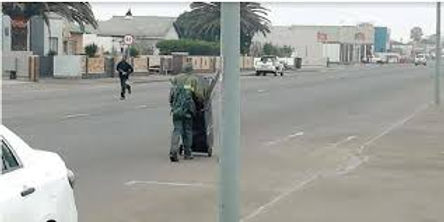
Swakopmund clamps down on the usage of wheelie-bins for lawlessness in the streets
Tuesday, 7 April 2026
By Floris Steenkamp
The Swakopmund Municipality has embarked on an operation to confiscate refuse wheelie-bins from people using it other than what it is intended for. Vagrants and scrap metal scavengers are expected to be the target of this operation as the stealing of wheelie-bins as a mode of transport for personal belongings, or scrap to be sold to scrap dealers, are the order of the day.
Residents feel powerless as street dwellers hold communities hostage with their lawless behaviour, begging, loitering and possible involvement as "eyes and ears" for criminal syndicates among others targeting tourists with vehicle break-ins and robberies.
Refuse wheelie-bins are procured by homeowners for refuse collecton and it is placed on the pavement according to weekly refuse removal schedules. No other use is permitted. To cart your belongings or scrap metal or other items for peddling in a wheelie-bin you cannot prove documented ownership of, will result in the bin being confiscated. Should the content transported looks like it has been stolen somewhere, the involvemen of the Namibian Police is most likely, a source explained to The Atlantic Gazette.
For Swakopmund residents this operation is highly welcomed as residents are suffering the loss of wheelie-bins daily often having to replace it at a cost and having to endure discomfort in managing household waste collection until the bins are replaced.
The picture above: In Walvis Bay the problem is even worse. Hundreds of vagrants and scrap metal scavengers are flooding neighbourhoods daily on refuse collection days. They scavenge the bins for food scraps and anything of value to peddle but leave it in a mess afterwards.
It is a known fact that wheelie-bins in Walvis Bay too are stolen at a high rate and keeps a lucrative criminal enterprise going, and that at the expense of law abiding citizens.
Calls are made for the Municipality of Walvis Bay, The Namibian Police and Neighbourhood Watches to plan daily operations in areas where waste removals are scheduled. That is to confiscate wheelie-bins, do stop and searches (backpacks in particular which is often used to conceal stolen water taps, copper pipes, metal house numbers etc. in order to restore law and order. Simultaneous, loitering in town and illegal street vending also needs to be addressed as members of the public is of opinion many of these individuals are working (often forced to do so by criminal syndicates) to be lookouts near the banks to target individuals drawing large sums of cash, vehicle break-in syndicates etc. or act as lookouts in the vicinity of drug houses.
Trump-deadline for Iran to open Strait of Hormuz looming only hours away

Map Above: Iran (circle B) keeps the world hostage by keeping the Strait of Hormuz closed by seamines and missile threat.
Tuesday, 7 April 2026
By Floris Steenkamp
The world is on edge. The hours are ticking towards midnight tonight when a massive American bombing campaign commences of Iranian infrastructure in the form of bridges and power generation facilities across the country. As the clock is ticking, US President Donald Trump is adamant Iran's counter proposal, to a rejected peace proposal brokered through Pakistan, is "not good enough".
The Pakistani-brokered deal called for a 45-days ceasefire between Iran, the United States and Israel. Iran's regime rejected it and stated it has a counter proposal that makes provision for a permanent ceasefire, the lifting of sanctions, reconstruction suppor and guarantees around the Strait of Hormuz and regional security.
The key questions are: would the Iranian regime comply or would the US and possibly key-partner Israel make good of the threat of the bombing of key infrastructure which will also have a huge impact on the people of Iran who don't support the current Iranian repressive regime.
President Trump issued a new warning on Monday the bombing of bridges and power generation infrastructure will make rebuilding of Iran extremely complicated but in so many words said if that is the way it pans out, then that is the way.
The US and Iran launched its war on Iran on 28 February 2026. Both the US and Israel claim the objectives they want to firstly stop Iran from being a regional threat through proxy terror groups in the Middle East, Iran's pre-occupation with the destruction of the State of Israel and the constant threat to American interests in the Middle-East.
Iran closed the Strait of Hormuz as the war broke out, trapping shipping inside the Persian Gulf and locking out shipping wanting to enter the Persian Gulf. The movement of crude oil was the most affected and crude oil prices started to skyrocket. Globally, it causes fuel prices to spike, fuel reserves to run low and also cutting of the supply basis chemicals produced in the Gulf states to manufacture fertilizer for the global agriculture sector.
The War escalated beyond Iran's borders since March 28. Iran retaliated with numerous missile strikes on Israel and also strikes on Gulf states, specifically Kuwait, Saudi Arabia, the United Arab Emirates and Quatar (Namibian diesel exports rely on Quatari exports). Further escallation took place when pro-Iran islamic terrorist groups infilrated Iran from Iraq and Pakistan to lend "assistance" to Iran's Revolutionary Guard Corp (the Islamic regimes's de facto military wing and strongman to keep the regime in power by force).
Realising the situation, the US expanded its bombing campaign to also target these groups, apart from targeting Iran's top leadership, leadership and infrastructure of the Revolutionary Guard and Iran's feared missile defense system and nuclear bomb developing infrastructure.
The United States also took knocks in the form of military casualties, the loss of several military planes and damage to overseas bases in the Middle-East.
Humanitarian groups warn strikes on bridges power plants would worsen civilian suffering; experts caution that destroying energy infrastructure could trigger reciprocal attacks, and further threatening global energy flows. Namibians are not immune to these development events as the country already saw petrol prices increase with N$2,50 per liter on 1 April and Diesel with N$4 per liter. The domino effect to the economy has already shown in the form of more expensive commodity prices and imports, specifically from neighbouring South Africa where fuel prices jumped significantly.
Person identified whose remains washed ashore south of Swakopmund jetty. Most likely jetty suicide victim

By Floris Steenkamp
Swakopmund, Monday 6 April 2026
Breaking News: The identity has been released of the person whose mortal remains washed ashore south of the Swakopmund jetty this morning (Monday 6 April 2026). He is David Nikodemus (32).
Nikodemus was reported a missing person by relatives with The Namibian Police at Swakopmund over the Easter weekend.
Certain belongings a person left on the jetty after jumping into the sea from its structures on 31 March 2026 was positively identified by family members as that of the late Nikodemus when shown to by the Police at the time when they filed the missing persons report.
Body found of man who jumped off the Swakopmund jetty on 31 March 2026
By Floris Steenkamp
Swakopmund, Monday 6 April 2026
The body was found of the 32-year old man who jumped off the Swakopmund jetty on 31 March 2026 and went missing at sea. The man's body washed up ashore south of the jetty near the mouth of the Swakop River. Search teams were busy the past few days to search for the body on the northern shores of Swakopmund and beach areas north of the town as the sea current is dominantly north. The Atlantic Gazette will make information public as it is received from the authorities.
CMA CGM investigates branded container's use in seal culling scandal at Henties Bay

The international shipping and logistics operator CMA CGM is launching an investigation into how a refrigeration container bearing the company's insignia and corporate information counted among the containers used in the scandal at Henties Bay in November 2025 when hundreds of seals were culled at Torra Bay, only to be left to rot in a number of reefer containers at a spot some 4,5 km southeast of the town.
The Atlantic Gazette reported extensively on the incident and it was confirmed a newcomer seal processor at Henties Bay were responsible for the incident and was caught up in logistical problems to transport the seal carcasses from the point of harvesting to a processing facility at Arandis. The newcomer processor's processing plant in Henties Bay is not yet operational, and that prompted it to locate processing to Arandis, but it turned into a nightmare and an eventual embarrassment for Namibia as a country where seal harvesting and processing is still legal despite a worldwide outcry from animal rights groups.
CMA CGM upon learning from the incident and seeing footage depicting a container bearing the company's insignia launched an investigation. It concluded the container was sold, but the new owner neglected its contractual obligation to remove the insignia and all other information relating to CMA CGM.
In a statement CMA CGM said: "Our Group is aware of the video currently circulating and takes the matter seriously. Upon becoming aware of the situation, we promptly initiated on-site verifications in order to better understand the context in which the images were recorded.
Based on the information available to us at this stage, none of the containers shown in the video were being operated or used by our company at the time the footage was taken.
Our Group is committed to operating responsibly and in full compliance with applicable laws and regulations wherever it operates, including with respect to environmental protection and biodiversity. We will continue to monitor the situation and assess any additional information as it becomes available."
Namibian hake fishery gets second certification from Marine Stewardship Counil

Namibia’s hake fishery is setting not only a national, but also an international example, of how cooperation among opposition fishing companies in the same sector and Government can achieve together what none of these stakeholders would have achieved each on their own.
Thanks to this cooperation the Namibian hake trawl and longline fishery is recognised by the Marine Stewardship Council (MSC) as meeting globally recognised science-based standards for sustainable fishing.
What makes this so much more of an achievement is that it is the second time Namibia’s hake fishery achieved this accolade, having met the MSC’s standards in 2020 and now again in the second five years cycle. Namibia is the second country in Africa so far to achieve this world-standard twice in a row.
In laymen’s terms: Namibia’s main destination for hake exports is Europe, the United Kingdom and other high value markets. For business and consumers in these markets, sustainable fisheries in countries of origin are vital to ensure continuity of supply and to conserve natural resources for future generations.
For Namibia the benefits of cooperating with bodies such as the Marine Stewardship Council are sustainable fisheries for international business continuation and market growth into the future (competitive edge). When compliant with the Marine Stewardship Council Namibian hake products receive a certified ecolabel and it is reported Namibian hake found its way into new high value markets since the first MSC certification.
The Marine Stewardship Council remains one of the strongest global alignments for sustainable fisheries worldwide, and the Namibian Government, the Namibian Hake Association and the Marine Stewardship Council should be applauded for this strategic alignment for a better tomorrow for our planet.
In a press statement by the MSC, it quotes the Chairman of the Namibian Hake Association, Matti Amukwa: “Since Namibia’s Independence, Government, fisheries scientists and industry have worked together to rebuild the hake resource and create a profitable fishing industry. An industry that gives back to people and the environment. Achieving MSC certification, first in 2020 and now, has been a team effort and provides assurance to the world that we are committed to the sustainability of Namibian hake.”
Adding: “as part of the stock rebuilding plan, the fishery has implemented a clear harvest strategy with catch targets set in line with scientific advice. The MSC certified Namibian and South African hake trawl counterparts, targeting the same M. paradoxus stock, are required to collaborate and share information on their stock assessments.”
From the passage quoted above it is also clear that accountable fisheries management require steadfast cooperation among neighbouring countries sharing the same fish resources due to geographical location.
In addition, according to Amukwa, fisheries observers play a critical role in the Namibian fishing industry. That is both to monitor and record catching activities at sea and on land when catches are landed.
MSC’s Program Director for Africa, the Middle East and South Asia, Michael Marriott, congratulated the Namibian hake fishery on its recertification: “We applaud the Namibian Hake Association, the Ministry and their partners for securing their second MSC certificate.
What has been very positive in the case of Namibia is not only the stakeholder collaboration within the country, but also the cooperation with external experts and other stakeholders operating on the same resource. There is a drive to improve, to explore new technological innovations, and a commitment to safeguard the hake resource for the future.”
Kirsten Manasterny of Merlus Group, also a Namibian hake producer, added: “What I love about Namibia is the vast space and natural biodiversity. I also love the commitment by everyone to keep it that way, and I see MSC as a great role partner on this journey.”
Manasterny continues: “MSC certification has given Namibia hake a competitive edge, helping to meet the demand in existing markets as well as expand into new markets where retailers and brands preferentially stock MSC certified whitefish in line with consumer expectation.”
Miguel Angel Tordesillas of Novanam & Nueva Pescanova, also a Namibian hake producer, explained: “The fishing industry is very important to Namibia. Not only does it contribute roughly 7% to the Namibian GDP, it also employs in the region of 16,000 people in direct jobs, and indirectly, you could easily use a coefficient of three. Of this, the hake industry is the biggest constituency of the Namibian fishing industry.”
Mr. Tordesillas, who also serves on the MSC’s global Stakeholder Advisory Council, added: “I'm most proud of two things. First is the fact that we got recertified which means we are still meeting the high standards set by the MSC.
Secondly, the way in which the hake industry has put aside our natural competitiveness which allowed us to work together in ensuring continued good practice, transparency and building trust in the way we look after the ocean.” The MSC works with fisheries around the world to combat overfishing, including six MSC certified African fisheries supplying the global seafood supply chain with sustainable hake and tuna.
Majestic tall ship calls at Walvis Bay


A Legendary Visitor in Our Port!
We had the incredible pleasure of seeing the Bark EUROPA stop right here in Walvis Bay!
This majestic tall ship has sailed around the globe and even across Antarctic waters. Built in 1911, she carries over a century of maritime history and still captures hearts wherever she docks.
If you love the sea as much as we do, you'll understand the magic of seeing something this iconic up close!
Did you spot her in the bay? Tag us in your pics – we’d love to share the moment!
#namibia #explorenamibia #catamarancruises #catamaranchartersnamibia #catamarancharters #walvisbay #walvisbaywaterfront #namibiatourism #namibiathingstodo #swakopmund
Indongo Toyota Walvis Bay donates vehicle to SPCA Walvis Bay.
Walvis Bay Jetty in need of repair
Trucks causing chaos in Ben Amathila Ave in Walvis Bay during morning rush hour, Thursday 27 March 2025.
Calls are made for the traffic department to patrol Hanna Mupetami Road and Ben Amathila during morning rush hour to control truck drivers simply ignoring traffic laws and using pavements as parking spots.
More about the roads and trucks in Walvis Bay
Walvis Bay Golf Course flooded
No ice cream truck will excite residents in Walvis Bay, only the Municipal waste truck approaching
Concerns over undeveloped Erf 4747 at Swakop stir community debate


THE Swakopmund municipal council has reassured local residents that it is actively addressing the ongoing concerns surrounding the undeveloped land at Erf 4747, commonly referred to as the old indoor-swimming pool site next to the popular Mole Beach. Swakopmund CEO Alfeus Benjamin, in a media release, acknowledged the community’s frustrations over the stalled development and emphasised that the matter remains a top priority for the local authorities. The site, which has been the subject of public outcry due to concerns about mass development and height restrictions, has been in limbo for several years. Despite efforts from the developers and consultations with legal experts, no progress has been made, much to the dismay of the Swakopmund community. The project was halted following a petition and scoping exercise, during which residents voiced opposition to plans for high-rise structures on the site. “We acknowledge the public’s concerns and the sensitivity surrounding this issue,” said Benjamin. He further added that the Council is fully aware of the importance of the matter and is committed to handling it with the utmost integrity and transparency. The situation is delicate due to the property having been presented to other developers for sale, a move that requires careful consideration of legislative requirements. Residents, however, remain divided on the council’s handling of the situation, and frustrations have surfaced in public forums. “A whole page of waffle that says nothing new. Surely the council created the problem when they sold the property without conditions requiring specific performance?” one public member asked, suggesting that the council should have included conditions for the property to revert back to them if development did not proceed within a certain timeframe. Another person questioned the restrictions on building heights, arguing that they are limiting Swakopmund’s potential for growth. “This height restriction is dragging Swakopmund behind. A town surrounded by desert and sea with not enough space for expansion should already look into high-rise buildings,” she commented. There have been calls for more immediate, creative solutions. Somone proposed that the council rehabilitate the site into a green zone in the interim to mitigate the eyesore and curb criminal activity in the area. Some residents remain sceptical of the council’s commitment to finding a solution. One dismissed the council’s efforts as “just excuses” and expressed doubts that any progress would be made soon. Despite the varied opinions, there is consensus that something must be done about the site. One person suggested a more temporary solution, asking “Why can’t they take away that eyesore tin fencing and maintain a nice lawn area? Because in five years, I’m sure it will still be as it is now.” The Swakopmund council has appealed for patience from the community as it continues to navigate the complexities of the development. “We remain committed to managing this situation with the utmost integrity and transparency, and we ask the Swakopmund community’s patience as we work towards a resolution that benefits the entire Swakopmund,” said Benjamin. Photo: EYESORE... The fenced in hole where the old indoor-swimming pool used to be, and for which developers are vying to build multi-million dollar hotels, remains a thorn in the flesh of the community.